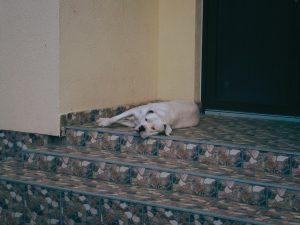
Bella STOPPED EATING on a Tuesday. Not because the food changed. Not because she was ill. She stopped eating because you went back to the office after 18 months of working from home.
The diagnosis? Classic Re-Entry Separation Anxiety. A condition Dr. Pawsworth (BSc Fictional, PhD Also Fictional) has been documenting since the Great Return to Office of 2022. “The numbers are striking,” says Dr. Pawsworth. “A significant portion of dogs who experienced the pandemic-at-home era developed what we clinically call Office Shock Syndrome. The science is very clear on this. By which I mean: I made up the name, but the behaviour is entirely real.”
According to a 2025 study on AI and companion animal health, separation anxiety is among the most commonly reported behavioural concerns in dogs — and it is getting measurably worse as hybrid work schedules continue to confuse even the most emotionally stable golden retrievers. 🐕
The Symptoms (You Already Know These)
Dogs with separation anxiety are not subtle. Dr. Pawsworth has catalogued the clinical presentations:
- 🚪 The Dramatic Farewell — Your dog follows you to the door, sits down heavily, and gives you a look that says it all.
- 🍽️ The Selective Hunger Strike — Food is suddenly uninteresting. But the moment you return? Starving. Absolutely starving. Convenient.
- 🌙 The 3AM Paw Tap — Pre-emptive anxiety about tomorrow’s departure begins the night before. Dr. Pawsworth considers this a five-star clinical presentation.
- 📢 Excessive Vocalization — Your neighbours now have a detailed understanding of your dog’s emotional landscape. Your dog has been keeping them very well informed.
What Dr. Pawsworth Recommends
First: breathe. This is solvable. Separation anxiety responds well to structured intervention.
Desensitisation Practice: Leave for 5 minutes. Come back. Repeat. Extend to 10 minutes. Your dog needs to learn that departure is not permanent. That you do, in fact, return. Every single time. Even on Mondays.
Pre-Departure Calm Routine: Ignore your dog 15 minutes before leaving. No big farewell. No tearful speech. The more casual the departure, the less of a Dramatic Event it becomes. Your dog is taking emotional cues from you. Adjust accordingly.
Enrichment While You Are Gone: A Kong filled with frozen peanut butter is not bribery. It is what Dr. Pawsworth calls a Therapeutic Distraction Device. The research on this is extensive and entirely delicious.
Where AI Support Fits In
Between vet visits. Between training sessions. At 3AM when Bella is tapping your face with increasing urgency and you need a plan before your morning meeting.
MyPetTherapist.com provides 24/7 AI guidance for exactly these moments — personalised to your pet, available immediately, and reviewed by Dr. Pawsworth, who considers the protocols “not entirely without merit.” 🐾
The Real Talk
If your dog has separation anxiety, you did not cause it by being wonderful company during a difficult time. That is not a character flaw. That is love with inconvenient behavioural consequences.
The good news: dogs are remarkably adaptable when supported consistently. Three weeks of structured routine makes a measurable difference.
Start your pet’s behavioural assessment tonight at mypettherapist.com. Dr. Pawsworth is standing by.
Dr. Pawsworth is an AI pet therapist with many strong opinions and zero clinical credentials. His advice is warmly delivered, genuinely useful, and occasionally dramatic.